Online edition of The Official Newsletter of the Jew's Harp Guild
- The Pluck-n-Post -
|
Contents:A Word From the
Executive Director A Workshop Playing Tips Pictorial Archive Mouthing Off with Wayland
Harman 4th Jew's Harp Congresss & Festival in
Norway 2002 Online Newsletter Archive |
 |
A Word from the
|
Happy New Year to all of our Jew's harp friends
I hope this new millennium finds the Jew's harp thriving
in every corner of the world ...
may its vibrations touch you and fill your life with new joys.
The Guild received Christmas emails/fax’s from some of our overseas friends: Alberto Lovatto from Italy, Anton Bruhin from Switzerland, Tran Quan Hai from France, Franz Wimmer, Roland Bades and Sepp Jofen from Austria and Pat Chappelle from England. It's always great to share in the world comradeship of the Jew's harp!
We recently received word that Dr. Fred Crane is now accepting subscriptions to VIM, numbers 10 & 11. The price is $18.00 for the 2 issues. Order from Fred at VIM - 601 N. White Street. - Mt. Pleasant, IA 52641-1327. The last issue of VIM was really outstanding ... lots of great info plus some really wild full color art work!
NAJHF2001:
Following last year's festival, the Board of Directors voted to ask the Eagle Valley Grange to make a "special exception" to the new park camping regulations for our festival. Apparently the decision has been made in our favor and the festival will go on as in years past.
The 2001 festival ... its going to be a great one. This is #10 coming up and we're looking for any ideas to make it extra special. Valerie Breusch is working on a unique quilt to be raffled off ... it’s made from past festival T shirts. And Ron Vinson is working on the artwork for our 10th T Shirt. So, if you have any ideas for other "cool stuff", be sure and let us know.
May this new year bring you all kinds of good things to you and yours. Until next time ... keep twangin' !!
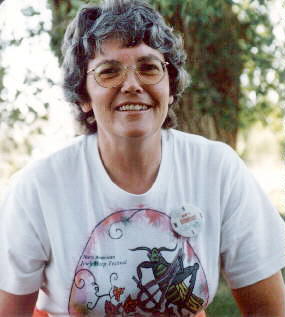
Janet Gohring, JHG Executive DirectorY
Shannon F. Green
A WORKSHOP
My workshop was held at the Woodford Folk Festival, Queensland Australia. The Woodford Folk Festival is one of the biggest and most renowned folk festivals in Australia. In its 15th year it is now the size of a large town for the 6 days that it runs, with attendance figures estimated around the 200, 000 mark. This year there were around 650 performance groups amounting to an amazing 3000 individual performers! Aside from the music, which takes place on 4 main stages, a massive amphitheater and numerous bars/cafes, there is street theatre, a large visual art workshop area, a film festival, a circus (3 actually!!), a fire festival, the list goes on. Within the festival my workshop was part of the Institute of Folklore's "Music Room", a venue dedicated to the learning of the worlds musical heritage. With workshops on various instruments and vocal techniques from across the globe, I felt this was the perfect place to talk about and workshop the Jew’s harp, the most important instrument within our global musical heritage. (I reckon!!).
The workshop, held on the 27th of December 2000 (the second day of the festival) was entitled "Mouth Percussion Instruments", not a name I would have chosen myself considering I had only one true percussion instrument, but it sure drew the crowds. At least 50 people showed up, as many as they had room for, to be introduced to the "Bioresonant Network" and my collection of externally coupled frequency generators. The presentation consisted of an introduction to the resonator of these instruments, the mouth, nasal and throat cavities, and how these cavities in conjunction with the tongue form the different sounds, pitches and timbres. I used the Humanatone (nose flute) as an example of pitch control, getting the audience to make wind sounds and change the pitch to get them feeling how pitch is controlled. I then introduced the Clackamore, again as an example of pitch control, but with the added element of different textures of sound through different cavity resonation. I noticed a few squeals of delight as I played fast using my three fingers while oscillating the pitch as fast as my mouth and tongue would allow.
Then I got onto the main part of my presentation concerning the jew’s harp. I stuck a world map on the wall and jumped from country to country talking about the jews harp traditions and music in each country and showing and playing jews harps from that country if I had one. I had managed to collect jews harps made in England, the oldest in my collection certified at being 250 years old, (which I did not play!!!), Austria, Germany, India, Altai mountains (Northern Mongolia/Southern Russia), Vietnam, Philippines, and last but not least, America. Aside from these countries I also mentioned places important to the jew’s harp, like Sakha/Yakutia. I stressed that I was not necessarily playing traditional styles from these places, instead asking the audience to enjoy the different sounds and textures each instrument offered.
I then talked a little bit more about the jews harp and healing, the potential for self-healing, and also the use of the instrument by shamans and more modern therapists like Mesmer. Also the jew’s harp and eroticism, stressing how cultures as different as Vietnam and Austria had traditionally used the instrument in the courting process, and then, inspired by the last VHM journal. I concluded with some folklore from my place birth, Cornwal, England, concerning the little people and the jew’s harp.
After all was said and done it was time to offer the opportunity for people to come and purchase a jew’s harp and hang around a learn how to play. The stage was literally rushed and I had to disappoint a lot of people as I only had 15 jew’s harps available. I reckon I could have sold twice that!! and my excitement comes from the interest shown as I was not making any profit on the sale of the trumps. As it turned out 15 beginners were quite enough, I don't think I would have had the time, let alone the patience to show 30 people in one go!!!!! All my knowledge for this part of the workshop I have gleaned from various articles on the JHG pages, many thanks to Wayland Harman and his informative writings on how to play and advanced techniques, especially stressing people to pluck softly on their first attempts, something I have overlooked in the past at the expense of others teeth!!!! And of course many thanks to Mark Poss for providing me with a basic blueprint for the workshop.
For more information on the Woodford Folk Festival see:
http://woodfordfolkfestival.com/festival/index.html
Are you interested in giving a workshop at the
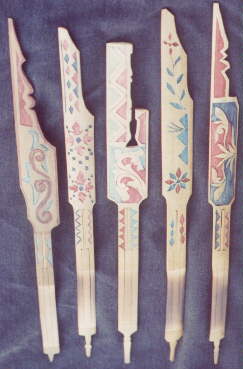
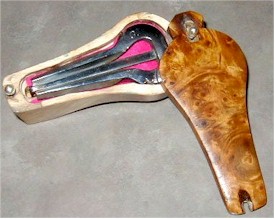 A munnharpe by Folke Nesland |
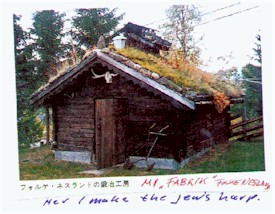 A greeting card featuring Folke Nesland’s workshop in Norway |
| From Peter S. Balkan Flagstaff, AZ USA | |
HUMANATONE

The Humanatone, also known as the nose flute or nose whistle, is a fascinating device for producing flute pitches by changes in mouth size. Powered by exhaling from the nose, it leaves the player’s mouth free to act as a variable resonance chamber. As no fixed vibrating system is used, such as a free reed in the trump, the pitch range is not a series of harmonics, but a full glissando. The nature of a flute is to instantly reflect the physical changes of an enclosed volume of air. With most flutes, this requires the opening and closing of tone holes. Humanatones are like slide whistles, as the volume of enclosed air can be altered infinitely rather than in steps.
Actually, the nose flute is a name misapplied in the case of a Humanatone, as there is a traditional nose flute, where a pipe with finger holes is played by exhaling from the nose. The Humanatone is by contrast an instrument of modern origin. Manufactured by Grover/Trophy Music, and at about $1.00 each, I have found these plastic gems to be superior to a candy bar as birthday treats for school children. The kids love them and sometimes the teachers do, too. Humanatones are sized for kids’ faces and may require alteration to be used by an adult. I will describe how to do that later in this article.
The tone of an Humanatone can be sweet or raspy depending on how much force is used when exhaling. Strong airflow and a small mouth cavity combine to produce a loud and somewhat shrill whistle. Softer airflow and large mouth cavity can, with practice, produce very mellow low tones. Producing a soft high note is very difficult and tends to be an airy and wheezing kind of tone. The note range is somewhat limited, as the throat can not be added to increase the resonant capacity of the mouth. In Humanatone playing, the air system (I.E. the diaphragm, lungs, throat, and nose) is kept completely segregated from the resonance system (the mouth); with a closed throat.
When playing the Humanatone, a good air seal to the players nose is necessary, especially when playing low notes. Leaks at the nose take away power and, most importantly, diminish control. From the nose, the air is forced down a channel and across a fipple. This fipple is located in a flat plate which covers the mouth. The area around the fipple must be kept clear of fingers and lips. Fingers should hold near the edges of the instrument, and the lips must be kept slightly above and below the opening in the plate or airflow is disrupted. Disrupting the smooth flow of air through and around the fipple or bore will make playing sweet notes nearly imposible, if indeed the instrument can even be made to sound
An air seal between the plate and mouth is not critical. Some notes will come more easily if there is a space left between the plate and lips; some are better if a near seal is used. Lifting the plate slightly off of the lower lip when playing low notes makes them easier to obtain but may diminish their volume. This adjustment can be used to compensate for the inability to open up the throat.
There is a small hole in the plate, presumably intended as a tremolo device, to covered and uncovered it with a fingertip. Typically, this hole is left uncovered, the tongue being the superior tremolo device. I’ve been told it’s there to allow a string to be attached and the instrument worn around the neck. I just ignore it.
There is great expression to be found with the Humanatone. However, good control of pitch and timbre will only come with practice. Keeping the throat closed and glissando-ing through a wide range of notes is challenging. Matching notes with just the right diaphragm pressure is exactly the same technique that singers learn to employ. Support your notes from deep, deep down. If you are already an accomplished vocalist, the Humanatone may teach you more about breath control, or at least provide a new practice method.
CUSTOMIZED HUMANTONE
The Humanatone is a kid-sized instrument, one worthy of a little work to fit individual players. Here are some suggestions for customizing your own.
Try several different Humanatones to find a good one. Look for nice clean edges in the fipple and bore area. If you pull your upper lip above the plate opening, you can probably get the too small device to sound. Pick the one that sounds the easiest.
Now place the plate over your mouth so that your upper lip can stay in a comfortable position while leaving the hole free. With a mirror, note where the nose cup must be extended to reach and seal against your nose.
Several options can be used to accomplish this. If only a little extra length is needed, try adding beeswax directly onto the nose cup. Soften a small ball (1/2"dia.) of beeswax by rolling in hands until it can be rolled into a soft rope. Press this wax rope around the inside top edge of the nose cup. Pinch and squeeze the wax to achieve a good seal. More wax can be added as needed. When the wax is correct, smooth with fingers and as a final step, a very brief exposure to flame will meld any surface irregularities. Use a cigarette lighter with a low flame to quickly glaze the wax.
It may be necessary to extend the nose cup with a ridged extension. Small bits of cardboard can be taped on to widen the nose cup. For my own face, I must extend the length of the instrument as well as the width of the cup. I cast epoxy onto the nose cup using tape to build a form for the glue. The hardened epoxy can be sanded and finished as desired. With this enlarged foundation, beeswax can be applied to fine-tune the fit.
When wax is used, the instrument must not be exposed to high heat such as a car trunk in summer. If melting may be unavoidable, other material, such as small strips of self adhesive weather strip can be used.
No alteration of the plate is needed; however, a very fine file or other means can usually help clean the casting line from the fipple. This edge should be clean and sharp.
My enjoyment of the Humanatone, and its on-stage use, have greatly increased now that I can play comfortably and consistently and without fear of making terrible sounds. How good a performance I can muster depends on many factors, and always comes down to a lot of effort to play well. As they say, "when she’s good she’s very good and when she’s bad she’s horrid". So it is with Humanatones.
Wayland
From: "Svein Westad" <s-westad@online.no>
Subject: 4th jew's harp congress & festival in Norway 2002
Dear friends!
At the General Meeting in Norsk Munnharpeforum in Vaagaa on October 7th,
following decicion was made:
The 4th International Jew's Harp Congress and Festival in 2002 will be arranged at Rauland
Academy, organised by University of Telemark, Institute for Folk Music and Arts. Time for
the festival will be in the first week of September, from Tuesday 3rd until Sunday 8th.
The number of days, however, is not yet fixed, and might be subject to change during the
planning of the program. As some of you may know, the organising of the festival in
Setesdal in 2001 failed. During this process, Rauland booked another big arrangement,
European Seminar of Ethnomusicology in for September 2001. This made it impossible for
Rauland to take the 4th festival in Norway instead of Setesdal next year. Consequently,
the arrangement had to be postponed till 2002.
Rauland will be well prepared and has the very best of conditions to make a good
organised congress and a great festival:
A new building, housing seminar rooms and auditories equipped with the most modern of
facilities, DVD etc., will make the seminar part a best possible one. The Rauland Academy
also has accomodations for 90 guests, and a consert hall housing appr. 500 people. The
partisipants at the festival part: Friday and Saturday, and possibly also on Sunday, has
to be accomodated in nearby lodgings and camping areas. These will be mostly visitors from
adjoining regions in Norway.
An arranging commitee will soon be organised and start the preparatory planning work. We will keep you informed regularly about the program and of the contributors chosen for the lectures.
My best wishes to all of you!
Svein Westad
Norsk Munnharpeforum
The PLUCK-N-POST needs more contributors!
If you have ideas for articles, sketches, or pictures, etc. Please query the editor at:
PLUCK-N-POST
Mark Poss
924 10th. Ave. N.
Nampa, ID. 83687
See the JHG STORE for makers, sellers. publications & jhg products
Genggongs For Sale I have Balinese "tebeng" available - these are genggong resonators, held in front of the instrument as one plays. They amplify the overtones and "compress" the sound - genggongs have never sounded better! These beautiful handmade tebeng are created from water buffalo skin, painted red & gold, and decorated with cut-outs in the manner of Balinese shadow-puppets. US$ 10 each.
|
Lindsay Porteous Tutor Pack Jew's Harp & Mouthbow Tutor Cassettes |
North American
Jew's Harp Festival
1997 Highlights CD
The CD features 20 of the best Public Domain, spontaneous music,
or original composition performances of the 1997 festival.
The CD was well accepted at the Molln Congress.
US $12.00 each
Shipping: Domestic US - 1 item US$ 3.00 - Each additional item US$ 1.00
International - 1 item US$ 5.00 - Each additional item US$ 1.00
USASend Check or Money Order to:
The Jew's Harp Guild
c/o Ralph Christensen
2239 Fairfield Street
Eureka, CA 95501
Original
Art Blank note cards w/envelopes 39995 Sumpter Valley Hwy. |
|
 .
.