Online edition of The Official Newsletter of the Jew's Harp Guild
- The Pluck-n-Post - A late addition, Jaw Harp Odyssey, has been added to the Bulletin Board (on July 24).
Also... Breaking News!... The Guest Book and Discussion
Group are now functional... (ed,)
Sponsored by:
|
Contents:A Word from the
Executive Director The Bulletin Board Online Newsletter Archive Index |
 |
A Word from the
|
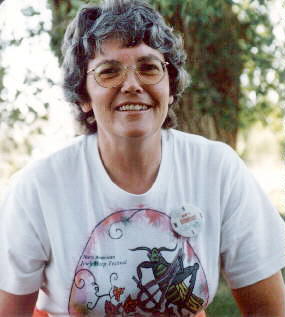
Happy Spring! I don't know about you, but I am very glad to have the winter of 98/99 over!! We had the most snow in 20 years ... and even as I write this, there is still another 4 feet in the yard waiting to melt!
We still have wonderful memories of the 3rd International Jew's Harp Congress in Molln, Austria. The Austrian Jew's Harp Association's Web Page is quite good ... there are several articles in English, plus they've just recently added many wonderful color photos of Congress Participants. Check them out at: http://www.stn.at/homes/maultrommel. Bill and I hope to have all of our "Molln Memories" in a scrapbook at the festival this year.
The Guild has added many new international members this past winter. And its so thrilling that many of these were folks we met in Molln last summer. We have a new sister Guild in Norway. Its so encouraging to see these organizations popping up, world-wide. I think the Yakutian's are right ... the Jew's Harp will be the instrument of the 21st century.
So, with Molln still lingering, our minds are turning to our own North American Jew's Harp Festival... only 4 months away! Its hard to believe this will be our 8th festival.
We have begun making plans and would appreciate any comments or input you'd like to contribute. WE VERY MUCH NEED more active volunteers to work at the festival. Special needs are a WORKSHOP COORDINATOR and a KID'S EVENT COORDINATOR for Saturday. These are hard positions to fill because they require someone who is not overly involved musically in the festival. The coordinator doesn't actually conduct the workshops, they only make sure everyone is prepared and that the workshops run smoothly. Let us know if you're interested.
It looks like this year's festival will be an INTERNATIONAL EVENT. We've already received tentative confirmation that we'll have folks from Norway and The Netherlands ... and we're still hoping to have Austrians and Russians in attendance, too.
Press Packets and Performer Registration Packets are now complete. Please remember to send a SASE with your inquiries. Hope to see you at the festival.
Some Jew's Harp tidbits of late ... We received word that Neal Stulberg, an American conductor living in Amsterdam, conducted Charles Ives' "Washington's Birthday" (which features a Jew's Harp solo) with the Netherlands Radio Chamber Orchestra.
David Wilke's print "The Jew's Harp" recently was auctioned off through the website "ebay.com". Guild member Pat Chappelle of England was high bidder. Dr. Fred Crane was able to obtain the original sheet music to "Jew's Harp Bill," written in 1930 by Arthur Fields and Fred Hall. The Guild's thanks go out to both Fred and Pat for sending the Guild copies of these! The copies will be on display at this year's festival.
That's all for this time! Take care and keep "twangin'"!! Janet *
 |
Be surprised
at the |
Recap of the Minutes The Jew's Harp Guild Board Meeting
February 13, 1999
Recap of the Minutes The Jew's Harp Guild Membership Meeting
February 13, 1999
PLUCK - Winter issue
PLUCK 'N' POST Spring; Summer, Fall issues
 |
What’s the Idioglot?
Two distinctly different types of instruments exist in the world of trumps (Jew's harps). The design most familiar to Western and European musicians is a steel frame into which a second piece of steel is set. The technical term for this type is heteroglot - made from two or more parts. The idioglot is made of a single part and is, as a matter of fact, the topic of this column.
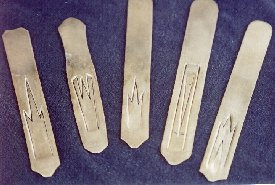
The first idioglot I saw was the Philippine Kubing. These wonderful instruments are hand cut from a straight grained bamboo stick, approximately 10" x 5/8" x 1/8". The exterior surface of the large culm (4-5") is present on one side. This is decorated by scratching away the smooth and blackening the resulting patterns. This artwork includes a family mark which identifies the maker. Keep in mind the Kubing is one of a very broad range of similar bamboo instruments. It is, however, the one with which I am most familiar. I will return to the Kubing after a look at the engineering of the idioglots, which can also be constructed of brass.
With a steel trump, a rigid frame holds a flexible reed that is plucked directly. The reed must be strong enough to withstand the plucking many, many times. The whole assembly requires contact with the player's teeth to achieve its full volume.
With idioglots, a flexible frame holds an even more flexible reed that is never plucked directly. The frame must be rigid enough to withstand many plucks, yet flexible to allow the pluck to transfer to the reed. As the frame snaps back straight, the reed cannot keep up and is left to catch up, which is the start of its vibration cycle. The reed must be very flexible to allow this.
No Contact Sport
No contact with the teeth is required to achieve full volume, just a little air. These instruments rest lightly on the lips, this being the most apparent difference to a steel harp player.
Kubings are played with the pretty side facing the audience. The holding hand FIRMLY holds the instrument with thumb and forefinger opposing each other, very near but not interfering with the free end of the reed. This firm clamping of the bamboo adds the mass, which is missing in this light and flexible idioglot. Holding the instrument more loosely will diminish its volume.
The embouchure (best playing spot) generally occurs at the free end of the reed, the last inch or so. This is where the reed is moving the most and the fastest. Your thumb should be close to this area and may well rest against your cheek. The instrument will rest on the lips or it will mute the sound a bit.
The plucking hand produces sharp plucks, not necessarily strong ones. The action is nearly percussive. A sharp release of the frame produces the strongest tone, usually but not always pulling the frame toward the player. Rapid forward and backward plucking is possible but difficult.
Due to the closed frame design inherent with this harp, the very straight pluck (in line with the reed's flexing) required with steel harps is not as critical. Plucking can occur at some angle to the end, and the reed will not be driven to click against the frame. This characteristic of the Kubing allows multiple finger plucks more easily than steel. Spreading the fingers of the plucking hand and raking them across the end yields a rapid succession of plucks. Finger plucks like those of a strung concert harp player, a scratching type movement, work well if the intensity and sharpness of the pluck is maintained.
While the volume of Kubings is less than a good steel harp, the tone is unique and satisfying, though the sound decays rapidly.
Big Brass
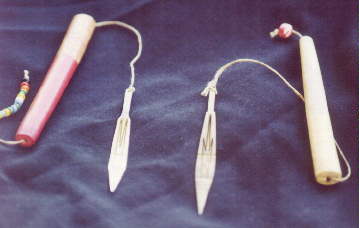
Akin to the Kubing, is the brass Hmong harp. These are powerful instruments and may have volume which rivals all but very loud steel harps. The sustain is long and true with air flow being extremely effective. Smaller than their bamboo cousins, a firm clamping of the frame is still essential. Some practice at supplying the necessary thumb and finger pressure will be needed. The flat side faces the audience and it is recommended that they be plucked toward the player only. Back and forth plucking may damage these somewhat fragile instruments.
Brass harps are great for singing with. The very flexible and relatively light reeds are so sensitive to air flow that even that of a sung note has effect. Matching the vocal frequency to the harps lowest pitch creates a powerful note. Some mismatches will yield three notes; the voice, the harp and the beats between the two. Singing the harp's low note while producing the high harmonics with mouth movement is easy and beautiful. These same techniques are available with steel trumps but take on especially silky attributes with Hmong harps.
While the mouth and throat manipulations used in playing the idioglots are very similar to those used in playing steel harps, there are a few differences. If a lot of air flow is used, the reed can be overdriven and lose its sustain, growling to a stop. Conversely, the air which can be forced through with a tongue thrust is enough to mimic a short blast of diaphragm air on a steel harp. When playing higher harmonics, the drone of the open reed is not as pronounced as that of the steel harp. This is especially true of the Hmong harp and may be due to the lack of contact with the players teeth.
Idioglots, being cut from one piece, have very tight tolerances. Steel harps must make more allowance for deflection in the reed's path due to direct plucking of the reed. In the construction of a Kubing, the parallel fibers of bamboo are pealed up between crosswise stop cuts, creating V shaped troughs with just penetrate the smooth side of the bamboo blank. With the complete outline of the reed just cut through a free flexing reed which is permanently aligned with the frame is created.
Hmong harps are cut from a brass blank approximately 3" x 1/2" x .025 thousands thick. The reed's shape may have a single long point or can be double-tongued (two long points) or may have an extra couple of short points at the base of 1 long point.
These reeds are carved from 1 side of the blank by cutting or scraping the metal until the outline of the reed is visible on the flat side without cutting through brass being fairly soft will distort before it cuts through. This distortion can be sanded off the flat side that completes the cut.
Once the reed is free to flex within its frame, adjustments are made to maximize playability. Both frame and reed are thinned in the area where they are joined. This increases flexibility and lowers the harp’s pitch and increases sustain. The reed's thickness may also be reduced to reduce mass and raise the pitch. Balancing these adjustments to bring out the best tone takes experience. Making an idioglot is a challenge and these instruments are cultural works of art. No trumpist's kit is complete without an idioglot, a wonderful alternative to steel harps. – Wayland
*
The PLUCK-N-POST and ON-LINE NEWSLETTER need more contributors!
If you have ideas for articles, sketches or pictures, etc. Please query the editor.
Soundbites & Stuff
Some older movies that have Jew's Harp music in them:
"Buck and The Preacher"
"Blazing Saddles"
"Summer of 42"
Magazine article in the March 1997 issue of NATURAL HISTORY, page 39
Books with references to Jew's Harps:
"Second Generation" by Howard Fast - Page 302 - reference to "geegaws"
"Two Roads to Guadeloupe" by Robert Lewis Taylor
pages 36 & 58
"A Journey to Matecombe" by Robert Lewis Taylor - pages 107, 116, 157
"Niagara" by Robert Lewis Taylor - page 248
"Panther In The Sky" by James A. Thom (the life story of Tecumseh) - page 651
"Bridget's Grace" - page 174
"The Power Of One" by Bryce Courtney - page 55
 |
Pictorial Archive Index
|
| We are an organization dedicated to preserving the
history and art of this, and other, ancient, unique, or culturally significant acoustic
instruments. Towards that end, we are developing a pictorial archive and database of these unique instruments. In the months and years ahead we hope to create the most comprehensive archive of this kind in the world. We hope you will join us in this effort and send us pictures, audio clips and information of your important finds. |
THIS IS THE Fifth of the series we hope to include in every issue of the Online Newsletter. The presentation of this column, and the entire archive, is in a state of construction. Please bear with us.
New features of this website will allow us to go forward with the publishing of
a full blown Pictorial Archive database. It will take some time as the learning curve is
steep and the data input, extensive. Please check back. |
Homemade Brass Trumps
|
RECORD # Name: Year: Country: Maker: Material: Length: Width: Handmade?: Manufactured?: Collection: Comments: |
#PA94 Brass Idioglots 1998 USA Wayland Harman Brass x x Yes no Wayland Harman Homemade |
Brass Hmong Harps
|
RECORD # Name: Year: Country: Maker: Material: Length: Width: Handmade?: Manufactured?: Collection: Comments: |
#PA58 Homng Harps ? Laos / Cambodia ? Brass/Bronze x x Yes No Larry Hanks Not loud, but long sustain. Very good sound. Carved from sheet brass. |
 Post Your Notes
|
We encourage everyone to send us news, questions, and other contributions!! |
JHG on CBC Radio One
Wednesday, April 28, 1999 2:29 PM
"Dear Mark,
Thought you would like to know that this morning I did a 25 minute radio interview with CBC out of Vancouver, BC on the Jew's Harp Guild. It will be aired sometime tomorrow (Thursday, April 29th) in the afternoon." Janet Gohring
Thursday's Highlights:
Everything you ever wanted to know about the jew's harp and more. A conversation with none less than the executive director of the American Jew's Harp Guild…
Then
Romanian Folkdance
Name: roger
Date: 4/29/99
HI. I heard about this web site by listening
to the cbc today. There is a Romanian Folkdance called, Floricica Olteneasca- a fast
complicated dance- with only the jew's harp. I thought you should know. It's a very
popular dance throughout the folkdance community.
thanks, bye.
_______________________________________________
If anyone had a chance to record this interview, please contact the JHG. We’d love to have a copy!
If you have ideas for articles, sketches, or pictures, etc. Please query the editor.
_________________________________
The Austrian Jew's Harp Association will organize an annual
international meeting of Jew's Harp Players, makers, scientists, and other people
interested in the field of the Jew's Harp. The aims of such meetings are encouraging
international know-how-transfer , scientific work and a general promotion for Jew's Harp
music. Because of the big success of the International Jew's Harp Festival 1998
and the 3rd International Jew's Harp Congress the Austrian Jew's Harp Association is
animated to take initiatives for further international contacts. Please take this chance
– we hope to see you in Molln. You will find further information in our Homepage http://www.stn.at/maultrommel
(Link: Treffen 99)!
Manfred Rußmann
Heinz Anzinger
_________________________________
Jew's harp of the Bukidnon people
A
t 10:25 AM 3/30/99 -0500, you wrote:Name: Hans Brandeis
Email: brandeis.hans@berlin.de
Hi,
Regarding the jew's harp of the Bukidnon people, Mindanao, Philippines, there is an updated version on my website now, including a new photograph:
http://freehosting.at.webjump.com/br/brandeis-webjump/bukid1.html
Regards, Hans Brandeis
_________________________________
Check out the new ODD Music website at:
http://www.oddmusic.com
The Early Music Network website is at:
http://www.earlymusic.net/
Don’t forget
North American Jew's Harp Festival
1997 Highlights CD
The CD features 20 of the best Public Domain, spontaneous music, or original composition performances of the 1997 festival. The CD was well accepted at the Molln Congress.
Only US$ 12.00 each
Domestic Shipping US$ 3.00
International Shipping US$ 5.00
Send Check or Money order to:
Playing Tips
Keep your ‘harp clean and dry…
Wipe it off after EVERY use. Store it in a dry place.
Use a "burnishing wheel" to clean it often.
Take Notes
Carry a small notebook in your kit! Keep notes on neat ‘harp combinations,
song ideas or lyrics, types of ‘harps your friends have… etc. etc.
---
North American Jew's Harp Festival
1997 Highlights CD
The CD features 20 of the best Public Domain, spontaneous music,
or original composition performances of the 1997 festival.
The CD was well accepted at the Molln Congress.
US $12.00 each
Shipping: Domestic US - 1 item US$ 3.00 - Each additional item US$ 1.00
International - 1 item US$ 5.00 - Each additional item US$ 1.00
Send Check or Money Order to:
The Jew's Harp Guild
c/o Ralph Christensen
2239 Fairfield Street
Eureka, CA 95501 USA
Jaw Harp Odyssey
Name: Lena Stella Strayhorn
Date: 6/23/99
Comments:
Greetings!
Having returned from a most fruitful pilgrimage, I look forward to enjoying the 1999 North
American Jew's Harp Festival.
At the 1996 North American Jaw Harp Festival, I had the great pleasure of hearing and
playing a Hmong brass "ncaas" jaw harp, presented by Ingrid Berkhout. Upon
experiencing this amazing instrument, I became convinced of the need to travel to the spot
where they were made, and to learn from those who produced such a perfect human creation.
After much research, I set out with a fellow jaw harp lover for Thailand, knowing only
that I was searching for the Hmong harp…
This jaw harp odyssey led us over two years to Thailand, Laos, VietNam, India, and
Indonesia. My traveling partner made incredible recordings of jaw harp masters we met
along the way, and I made some photographs along our journey. Some of these recordings
will be released on CD in the near future, and a book on our pilgrimage is in the making.
Punk camel-drivers playing jaw harp under the stars in the dunes near Pakistan; the man
with the longest mustache in the world, fine jaw harp player and son of a famous bandit,
who showed us his father's saber during a night of jaw harps and whiskey in his cow-dung
hut; heaven on earth at the border of China, where 12-year-old shaman girls sing the songs
of fairies through their harps; an aged blind hermit holyman comes down the mountain to
bestow magickal genggong songs on us in Indonesia…
I will have available for sale a few of the harps I collected, and I'll present some
photgraphs.
The San Francisco Interstellar Jaw Harp Society has been dispersed to many parts of the
earth over the past two years, so I can not provide an update on its activities. I can,
however, note that I performed last week at a benefit show for Annie Sprinkle, a
"post-porn goddess" who lost her houseboat in a fire. As I, bedecked in gold and
carnelian, played a Hmong harp, my friend Wanda Lust wove a poetical tale of sensual
adventure.
See you at the Festival!
Love,
Lena Stella Strayhorn
(You are welcome to post this on the JHG website, if you like!)
Back to Newsletter Index
 |
M. D. Poss
|
New JHG Website Features
_________________
S
everal months ago we announced the switch to the www.jewsharpguild.org website address, and mentioned some of the new features that would be forthcoming. Well, at long last, I have nearly completed the full update!I am aware that not everyone is internet ready… but I feel compelled to inform our readers of the new website features so they may pass the info along to friends and cohorts. Also I view the PLUCK-N-POST as a vehicle to disseminate information gathered on the internet… and the website, to pass along info gathered by more traditional methods.
New website features include: the first 100 records of the JHG Pictorial Archive; site search engine; archives of past on-line newsletters, and Guest Book. The old "Harpist on the Web" page has been replaced by the Guest Book. Please sign in!! A on-line discussion group is in the troubleshooting stage and should be operational soon as well.
The website has become a wonderful resource for the Guild and its members. Nary a week goes by that we don’t hear from someone new. This includes contacts with folks like the CBC (see the Bulletin Board), museums, and an array of music organizations.
Newsletter Changes
Some policy changes are evident in this issue of PLUCK-N-POST. The "mailer" section has been removed to provide more space… and we’ve opened the door for outside advertising in the hope additional revenue will enable us to provide you with a better newsletter.
As always, we are looking for new contributors of tidbits, articles, cartoons, and pictures for JHG publications.
Farewell to EMI
Bart Hopkin’s Experimental Musical Instruments has ceased publication after a fantastic run of 14 years. EMI will continue many facets of business on it’s website at:
http://www.windworld.com/emi. I cannot express the gratitude I feel for the influence this publication has had on me personally. Not only for introducing me to new concepts and interesting people, but also for Bart’s editorial example of what a musical periodical should be.Bart and EMI have supported the NAJHF since its birth, and have been a source of Jew’s Harp information for many years. We extend our thanks for a job well done and best wishes for future endeavors.
Happy ‘Harpin’ ! – Mark *